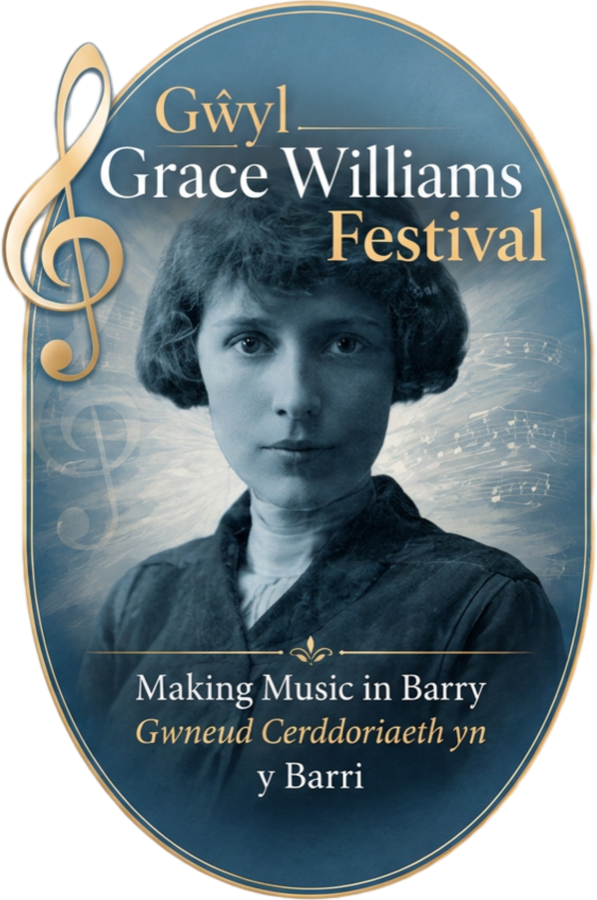
Fifty years after her death, Grace Williams, from Barry, who studied with Vaughan Williams, wrote the first British feature film score by a woman and came home to write music inspired by the sea, is to be commemorated in a month-long festival in her hometown.
Barry produced one of the most gifted Welsh composers of the twentieth century, and Grace spent much of her working life in the town, looking out over the same stretch of the Bristol Channel that still draws people to the Knap and Barry Island.
In February 2027, half a century on from her death, the new Grace Williams Festival is staging a month of concerts, history walks, film screenings and art across the town.
A musical household in Barry
Grace Mary Williams was born in Barry on 19 February 1906, the eldest of three children. Both her parents were teachers, and music ran through the house. Her father, William Matthews Williams, was an accomplished musician who conducted the Romilly Boys’ Choir, so the young Grace grew up with rehearsals and part-singing as part of everyday life.
At Barry’s County School for girls, her music teacher, Rhyda Jones, spotted something special and encouraged her to compose. From there Grace won a scholarship to the university college in Cardiff, then went on to the Royal College of Music in London, where she studied composition with Ralph Vaughan Williams. A travelling scholarship then took her to Vienna to study with Egon Wellesz.
London, war and the sea
Through the 1930s Grace taught in London: at Camden Girls’ School and Southlands College. When war came, her college staff and pupils were evacuated to Grantham in Lincolnshire, and it was there, a long way from the Welsh coast, that she wrote two of her best-loved pieces: the Fantasia on Welsh Nursery Tunes and Sea Sketches - a suite for strings that many listeners hear as a portrait of the coastline she grew up beside.
After the war she came home to Barry, where she spent the rest of her life composing, teaching and writing for radio. (Sources differ slightly on the year of her return, giving either 1945 or 1947.)
A first for British film
In 1949 Grace wrote the score for Blue Scar, Jill Craigie’s drama set in a south Wales mining community. It made her the first British woman to score a feature film, a fact that still surprises people today. The festival is screening Blue Scar in Barry, so this is a rare chance to hear that score in its proper setting.
Other milestones followed. Penillion, written in 1955 for the National Youth Orchestra of Wales, became one of her most popular works, and her one-act opera The Parlour, based on a Guy de Maupassant story, was first staged in 1966. She was, by all accounts, a quiet and modest woman. She turned down an OBE in 1967, and she destroyed a number of her own early manuscripts because she felt they were not good enough to survive.
Grace Williams died in Barry on 10 February 1977, aged 70. Her manuscripts are held by the National Library of Wales.
Fifty years on
The festival organisers say they want “not only to celebrate Grace Williams herself, but also to raise her profile and make sure that her music is not forgotten in her hometown.” They also hope the festival will “show the positive impact of music on personal well-being and inspire new generations of Welsh musicians in the town.”
The programme runs through February 2027 and mixes Grace’s own music with the wider sound of Barry today, from acoustic sets in bars and cafes to full orchestral concerts at All Saints’ Church.
Gala concert with Jeremy Huw Williams
The headline event is a gala concert of Grace’s songs by the renowned Welsh baritone Jeremy Huw Williams, himself a Vale man, born just up the road in Dinas Powys. It takes place at All Saints’ Church, Barry, on Saturday 13 February 2027, at 7.30pm, and earlier that afternoon the same venue hosts Tea with Grace and Friends, with musicians from the Royal Welsh College of Music & Drama.
History walks, film and more
Grace Williams History Walks take place on several afternoons through the month, including one in Welsh on 28 February. Blue Scar is screened at Ysgol St Baruc on 7 February, and the documentary Grace Williams: an Enduring Fight is shown once, on 10 February, with a Q&A at the Town Hall. Other highlights include Returning Home: Songs by Grace Williams at All Saints’ Church on 6 February, the Welsh piano duo Sonant at the Town Hall on 19 February, a Barry Community Orchestra family concert on 21 February, and the City of Cardiff Symphony Orchestra at All Saints’ Church on 27 February. Local contemporary songwriters will showcase their work, and there are folk, jazz and art events – each aiming to celebrate the life and work of this remarkable citizen of Barry.